Descanso Gardens transforms into a one-of-a-kind nighttime experience each winter season with Enchanted: Forest of Light, running from late November through early January. The 150-acre botanical garden in La Canada Flintridge becomes a glowing landscape of illuminated art installations, light tunnels, reflective pools, and custom soundscapes designed to guide visitors through the garden after dark. Each section of the garden tells its own visual story. The California Sycamore Grove, the Rose Garden, the Oak Forest, and the Japanese Garden all receive distinct light treatments that make familiar daytime spaces completely unrecognizable at night. Descanso Gardens is located at 1418 Descanso Drive in La Canada Flintridge, about 15 minutes north of Pasadena via the 210 Freeway. Parking is available on-site. Timed entry tickets are required and sell out quickly — book well in advance at descansogardens.org. Children under 3 are free. The experience takes approximately 90 minutes to walk. Dress in layers as November and December evenings in the San Gabriel Mountains can be cold. Bring a jacket, wear comfortable shoes, and plan to arrive 10 minutes before your timed entry slot.
Before this city had a name, it had artists. LA NDN Flea is a Native American market that gathers indigenous makers from across the region to sell original art, jewelry, textiles, and handmade goods at the East West Bank Plaza adjacent to The Broad in downtown Los Angeles. This is not a museum exhibit about indigenous culture — it is a living marketplace where the people making the work are standing behind the tables, and the work is contemporary, not historical. Family-friendly activities and DJs round out the afternoon. Saturday, December 13 from 10 AM to 5 PM. Free entry. The plaza sits at Grand Avenue and 2nd Street in the heart of the DTLA arts district, steps from The Broad, MOCA, and Walt Disney Concert Hall. The vendor roster includes original art, beadwork, ceramics, screen-printed apparel, and packaged foods from indigenous-owned businesses across Southern California and beyond. The kind of market where the thing you buy carries a story the maker can tell you in person while you hold it.
While you are lookingDifferent scene, same night out.
Every 1st Friday· Next Nov 6
Free
920 Kline St, La Jolla, CA 92037
Once a month the light off the Pacific hits the gallery corridor at exactly the right hour, and everything hanging on those walls looks better than it has any right to.
The format is self-guided, which is the point — you pick the route, set the pace, and let whatever you are standing in front of decide how long you stay. Galleries pour wine and put out snacks. Thumbprint on Kline Street is the unofficial anchor, and if you only have an hour, start there and let it carry you.
More than 400 people turn out each month, which is enough to feel like a neighborhood showing up for itself and small enough that you will end up talking to a gallerist without planning to. The theme shifts month to month; the character does not.
First Friday of every month, 4 to 7 PM. 920 Kline St, La Jolla. Free, with evening street parking on most blocks.
Short enough to finish in an hour. Long enough to lose the whole evening to, if you let it.
Somewhere in your home is a stack of books you bought because of the person you intended to become, and you have finished maybe two of them. This is a festival for that person. Not the one who reads everything — the one who keeps buying.
Miami Book Fair has taken over downtown Miami every November since 1984, and by its own reckoning it is the longest-running and largest literary festival in the country. The 2026 edition runs eight days, brings in more than five hundred authors, and ends with a three-day street fair that costs nothing to walk into.
What it actually feels like is a neighborhood that has been handed over. The Wolfson Campus of Miami Dade College and the downtown streets around it close to traffic and fill with some two hundred and fifty exhibitors — university presses, Caribbean publishers, comics people, zine tables, a man who only sells cookbooks. Programming runs in English, Spanish and Haitian Creole at the same time, in adjacent rooms, and nobody treats that as an accommodation; it is simply what a book fair in this city sounds like. Smorgasburg sets up in the middle of everything, so the air smells like charcoal and fried dough rather than paper, and the line for a novelist you have never heard of is frequently longer than the line for the one you came for.
Worth the trip? If you are the sort of reader who checks the acknowledgments page to see who somebody thanked, yes, without reservation. This is not an afternoon in a quiet bookshop. It is hot, it is loud, it is shoulder to shoulder by noon, and the good conversations happen standing up in a crowd. If that sounds like an ordeal rather than a pleasure, this is not your festival and there is no shame in that.
Things worth knowing before you go: gates open an hour before programming, and that hour is the only time you can pass a table without turning sideways. The street fair is free, but individual author sessions are ticketed separately and the recognizable names sell out weeks ahead. The eight-day fair opens on the fifteenth, five days before the street fair starts, with evening readings that people outside Miami mostly never hear about — those rooms are small and the writers linger.
A city written about mainly as a place people go to stop thinking spends one week each November as the most serious literary town in America. Most people reading this will never go, and will still think about it come November.
Street Fair: Friday, November 20 through Sunday, November 22, 2026. Gates at nine, programming from ten. 300 NE Second Ave, downtown Miami. Free admission.
Monthly· Next Nov 11
Free
Gaslamp Quarter, 5th Ave & G St, S…
You have walked these blocks a hundred times on the way to dinner and never once noticed the staircase between two storefronts, or the room at the top of it with somebody's paintings on the walls.
Last Saturday of the month, the doors that are normally shut get propped open. Galleries, boutiques, studios above street level, spaces you assumed were offices — all of it self-guided, so you set your own route and nobody herds you anywhere. Live music turns up at several stops. Artists stand next to their own work and will talk to you about it if you make eye contact, which is rarer downtown than it ought to be.
The Gaslamp on a warm evening already does half the work. The rest is free, and it bridges an afternoon into a night out better than any reservation.
Take the person you have been meaning to catch up with. You will end up talking more than looking, and that is fine.
Every 2nd Thursday· Next Nov 12
Free
Gallery Row, 300 S Spring St, Los …
The second Thursday is the one night the galleries stop pretending they want you to be quiet. Doors that are normally appointment-only on Spring Street are propped open, the Historic Core fills with people who are not art buyers, and the whole corridor between 3rd and 9th behaves like a street fair that happens to have paintings in it.
What keeps it from being a tourist thing is that the galleries are real and still working — you are walking into studios, not pop-ups, and the person who made the piece is usually standing near it with a beer, which is a far better way to look at art than a wall label. Pick up the free map at the Art Walk Lounge and then ignore it, because the point is the drift. Food trucks park wherever they like. Somebody is always playing saxophone badly and nobody minds.
Six until ten, every second Thursday, no ticket. A city that is supposed to have no street life has had this one for twenty years.
In 9 days· Nov 14 – Nov 15
200
Dodger Stadium, 1000 Vin Scully Av…
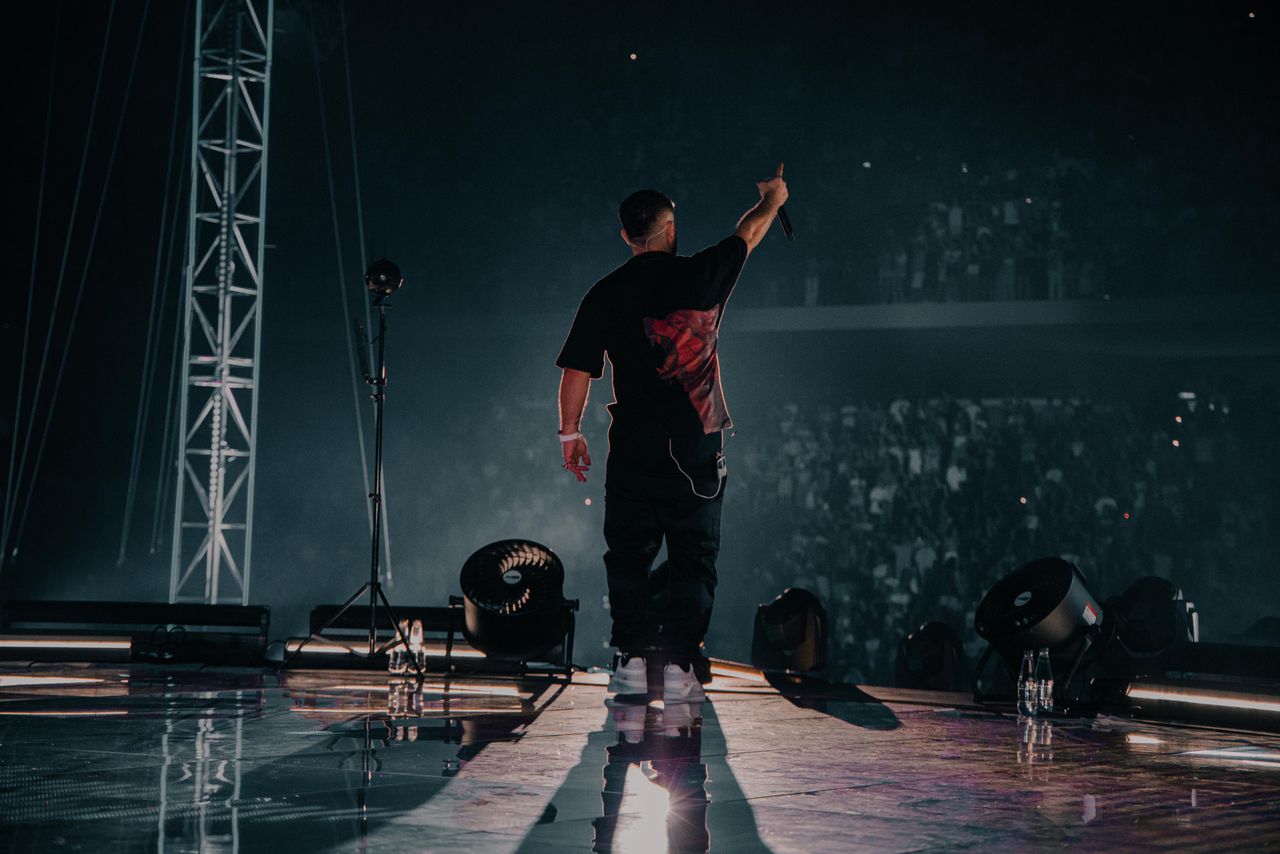
Tyler the Creator builds his festival the way he makes his albums — as a complete vision, not a lineup. The 2026 edition runs November 14–15 at Dodger Stadium: Tyler himself, Andre 3000, Erykah Badu, Playboi Carti, Earl Sweatshirt, Vince Staples, Daniel Caesar. Sixty thousand people. This is his current read on what matters. Flog Gnaw feels nothing like a conventional music festival. Tyler's aesthetic — Golf Wang colors, surrealist visual direction, Converse collabs, the cartoon universe he's been building since Odd Future — pervades every inch of the grounds. The headliner list reads like Tyler's personal taste index rather than a booking agency's safe plays: Andre 3000's rare public appearances, Earl Sweatshirt's deliberately sparse touring schedule, legacy artists like Erykah Badu alongside younger voices. The surprise guest tradition is genuine — in past years unannounced performers have drawn more conversation than the headliners. The crowd skews young, fashion-conscious, and culturally literate in a way that is self-selecting. Flog Gnaw is the festival where people bring cameras for the fits, not just the performances. This is for people whose music listening doesn't fit a single genre label — who have Tyler the Creator, Badu, Earl, and Daniel Caesar on the same playlist and see nothing contradictory about that. It is for the aesthetically curious. It is not for people who want clear setlist times, grid-pattern stages, and predictable headliner slots. Tyler runs his festival on his own logic, and that's the point. If that energy resonates, Camp Flog Gnaw is one of the few festivals where the curation is unambiguously the product. Two-day passes sell significantly faster than single-day. The Dodger Stadium location is accessible by Metro (Dodger Stadium Express from Union Station — skip the parking). Merchandise drops at Flog Gnaw are serious and sell out quickly; the Golf Wang collabs available only at the festival have become collector items. Arrive early day one — the grounds have carnival rides, food, and art installations that reward exploration before the headliners. Andre 3000's live appearances remain rare enough to justify the trip from anywhere in the country. Tyler the Creator built a world — Golf Wang, Odd Future, Igor, Call Me If You Get Lost, Cherry Bomb — and Flog Gnaw is where that world becomes a place you can stand in for two days. The music industry produces thousands of festivals. Very few of them feel like they could only exist because one specific person willed them into being. Flog Gnaw is one of them. Tickets at Ticketmaster. November 14-15, 2026, Dodger Stadium, Los Angeles.
Dec 2 – Dec 7, 2026
Miami Beach Convention Center, 190…
You leave having seen things that will show up in auction records and retrospectives for the next decade - and you did not have to buy a single piece to be part of it. For one week in December, Miami Beach becomes the most concentrated gathering of contemporary art in the Western Hemisphere: 250 galleries from 30 countries, and a city that builds its entire social calendar around them. The main fair at the Convention Center is overwhelming in the best sense, with galleries from New York, London, Tokyo, and Sao Paulo competing for attention across a space that would hold several football fields. Wynwood's murals and the Design District's boutiques become satellite venues. Opening-night parties are invitation-only, but the energy of the week bleeds into every restaurant and hotel lobby in South Beach. This is not a quiet museum experience - it is a city in a specific, charged state of collective attention that happens once a year and then recedes. It is worth attending even with no intention of buying: the public programming includes talks, artist installations, and outdoor screenings, and the works you encounter at the main fair and at satellite shows like Untitled, NADA, and Scope are what the contemporary art world is actively debating in real time. If you care what art is doing right now, this is where you go to find out. Secure a hotel early - December in Miami Beach is peak season and fair proximity commands a premium. The main fair requires a ticket ($50-100 depending on day and time); many satellite fairs are free. RSVP to gallery openings in advance through their own websites, and book Design District restaurants weeks out. A car or rideshare is more flexible than the free shuttle. The main fair is most crowded on preview days (Wednesday and Thursday) and thinnest on Sunday, when collectors pack up their acquisitions. Miami absorbs the energy of the global art market and does not quite release it until January. December in Miami Beach.
Want personalized recommendations?
Create a free account and we'll surface events matched to your taste.